


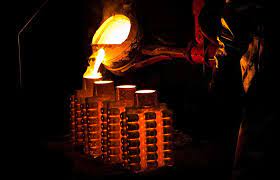
Understanding Precision Casting
Pengecoran presisi refers to the production of precision-sized casting parts. This process is superior to traditional casting as it produces castings with higher accuracy in dimensions and with a good surface finish.
Therefore, the process can easily produce the desired parts quickly and precisely. Such parts are usually ready to use straight away without any treatment or preparation. This advanced near-net-shape manufacturing technique may be useful for small-volume orders.
There are several types of best precision casting, including investment casting, ceramic casting, metal casting, pressure casting, and lost foam casting. Investment casting is the most widely used type to produce both ferrous and non-ferrous metal castings.
Investment casting, also called lost wax casting, is a technique that uses wax to create a mold for metal parts. The procedure produces more precise and smoother finishes compared to traditional sand casting.
A suitable material like paraffin is used to make the investment mold. A refractory material coat is applied on this material and ground down to create a hardened outer shell.
The inner mold is melted and then preserved to make it strong enough, forming the cavity.

Once incinerated, the remaining pot material is cast with the metal.
The heat-treated and cold, it is cooled and shelled and then sand-cooled. This leaves a very accurate final product.
Precision castings also have more design freedom and may be made of many different types of steel or alloy steels. This makes them the finest-quality castings on the market today.
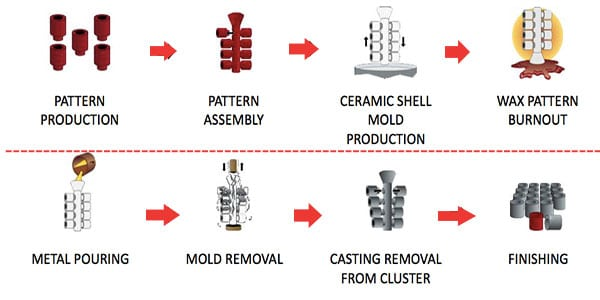
Precision Casting Process
- Mold Design:
Engineers can complete the mold design according to the drawing, and the mold is purchased from the foundry. - Wax Injection:
The wax is injected into the mold by a machine. The pattern of the desired cast is produced by pouring molten metal into the mold. This process is called patterning. - Assembly Tree:
A central wax stick called a sprue is attached to the patterns to form a casting cluster or assembly tree. - Shell Making:
The shell is created by immersing the unit in a liquid ceramic slurry and pouring layers of excellent sand over it. Up to six layers can be applied this way. After each layer dries, the shell will be ready for another coat. - Dewax:
The drying ceramic is heated to melt the wax inside the shell. - Pengecoran:
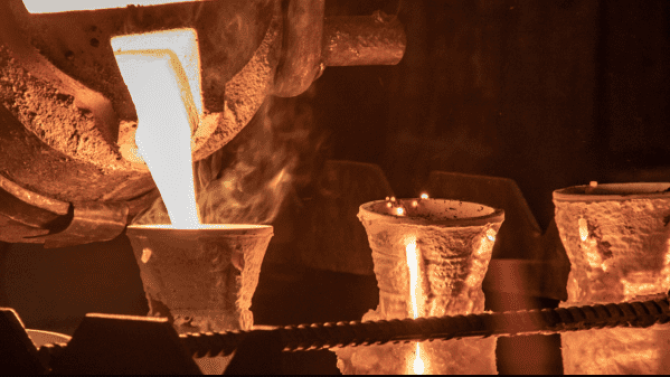
In a traditional casting process, the mold is filled with melted metal by gravity. As the metal cools down, parts, pouring cups, frames, and gates become solid castings. - Knockout:
Crushed ceramic shells result from knocking out the knockout or vibration machine after they have been cooled and solidified. - Cut-off:
The pieces are cut from the center section with a high-speed saw. - Grinding:
Once the plaster is removed, then carefully ground. - Inspeksi & Post Treatment:
The casting is checked by the inspector for accuracy and quality with the help of the drawing and specifications. Any unqualified parts are repaired, re-checked, and replaced. - Finished Castings:
Once surface treatment is over, the metal castings resemble precisely the original wax models and can be sent to customers.

Why Choose Kbear Metal for Precision Casting?
In the realm of precision casting, Kbear Metal stands out as the best choice for several compelling reasons:
1. Expertise in Precision Casting Techniques:
Years of industry experience stand firmly in the company’s favor as Kbear Metal presents itself with high-end precision casting techniques.
From wax pattern to flawless metal pouring, no stone is left unturned while delivering pieces that will meet the precise specifications of your job.
2. Cutting Edge Technology:
Technological advance: Kbear Metal always keeps up with the most current technology.
All of our facilities maintain state-of-the-art equipment for wax pattern production, ceramic shell construction, and automated metal pouring to provide unmatched accuracy and efficiency.
3. High-Quality Materials:
We source the finest metals and refractory materials to ensure the durability and performance of your components. For stainless steel, aluminum, or other specialized alloys, we guarantee high quality at Kbear Metal.
4. Custom Solutions:
Each project is unique, and we pride ourselves on being able to deliver custom solutions that match your specific requirements.
Our team is willing to take the time to understand what our clients need and to supply parts that fit in perfectly with their goals.
5. Excellent Customer Service:
Kbear Metal values its clients and endeavors to provide an excellent customer experience from consultation through to delivery, ensuring timely completion of the projects.
6. Track Record of Success:
Our portfolio offers a successful collaboration with clients across various industries, including aerospace, automotive, medical, and industrial sectors.
You can rest assured your project is in the right hands with Kbear Metal.
Key Techniques for Precision Casting
Precise casting can only be achieved by combining state-of-the-art techniques and meticulous planning with state-of-the-art equipment. Here are some best practices to ensure success:
1. High-Quality Wax Patterns:
The process of precision casting is founded on the wax pattern. Accuracy in a wax model plays a critical role in shaping the eventual product with proper measurements. To develop high-quality patterns:
- Use fine wax material for consistent results.
- Apply using highly accurate replicating automatic injection machines.
- Diets for wax patterns should be regularly inspected and maintained.
2. High-Performance Ceramic Shell Fabrication:
The ceramic shell serves as a mold for the molten metal, and its quality will ultimately impact the casting’s surface and dimensional precision. Techniques to improve shell fabrication include:
- Building up: Apply multiple ceramic layers to provide a stable shell that is thermally and pressure-resistant.
- Drying Control: Each layer shall dry uniformly to prevent defects.
- Refractory Materials: Only the highest-grade materials that can take up the thermal stress of the molten metal without breaking or deformation are used.
3. Accuracy Metal Pouring:
Metal pouring into the mold filled with molten metal can be very crucial. The various essential considerations in precision casting include:
- Temperature Control: Maintaining the metal at a suitable temperature not allowing it to solidify before mold filling.
- Pouring Speed: Pour at a controlled speed so that turbulence doesn’t form, which creates air pockets or inclusions.
- Vacuum Casting: If vacuum-assisted casting is used, it removes the air bubbles and also fills the mold cavities for high-quality casting.
4. Investment in Automation:
The modern precision casting process allows for greater automation with respect to improving accuracy and efficiency. Tasks such as wax pattern assembly, shell dipping, and metal pouring can all be handled with incredible accuracy by robots and CNC machines. Besides error minimization, automation also accelerates the production cycle, making it an invaluable technique in high-volume manufacturing.
Benefits Of Investment Casting Over Sand Casting
1. Good Surface Finish:
Investment casting provides a much better surface finish than forging and sand casting. This may be crucial, especially for parts that will be machined further or need to be edited.
2. Thin-Walled Castings:
It produces thin-walled castings that increase precision and minimize waste.
3. Closer To The Design Of Finished Parts:
Investment castings allow parts that are near-net-shape, saving on machining. Holes, slots, undercuts, and other complex features can often be made that cannot be done with other processes. This is especially an advantage in working with expensive alloys such as nickel-cobalt.
4. Fewer Cast Defects:
Investment casting is a cleaner and more thorough process than sand casting. This means that investment castings produce far higher percentages of problem-free castings.
5. Tight Tolerances:
Investment castings can be formed to considerably tighter tolerances than sand castings or forgings.
6. Competitive Tool Costs:
Investment casting is often less expensive than sand casting because the initial tooling cost is lower. The mold is directly derived from the wax pattern. Since the process does not require a separate tooling process, it eliminates the cost of producing the mold.
Why Precision Casting Matters
Pengecoran presisi is not just a process of manufacturing; it is way above the process itself-it’s a solution that empowers industries to innovate and become better.
It’s all about manufacturing complex, performance-intensive components with minimal waste to satisfy today’s needs for contemporary engineering and sustainability.
Precision casting is one of the best options available for businesses looking at reliability, versatility, and excellence.
Its ability to accommodate all types of materials and the advancement of 3D printing and simulation software help it continue to be one of the manufacturing technologies.
Kesimpulan
To sum up, The mastery of precision casting requires the combination of traditional techniques and innovative technologies, side by side with a deep understanding of the process.
Whether it is perfecting wax patterns or using automation and simulation tools, each step allows for the achievement of the utmost level of quality.
With a wide array of applications and the ability to meet any stringent demands, precision casting remains a cornerstone of modern manufacturing.
Whether in the aerospace, automotive, medical, or industrial sectors, investment in precision casting ensures that your components are ahead of their peers in terms of durability, functionality, and design.
In light of these best techniques and innovative approaches, manufacturers can tap into the full potential of this outstanding process and set up standards that will be of quality and performance.



