


Shell mold casting is a time-tested manufacturing process that combines precision and efficiency. Known for its ability to produce complex shapes with exceptional accuracy, it has become a popular choice across various industries, from automotive to aerospace.
In this blog, we’ll explore the fundamentals of shell mold casting, its benefits, limitations, and the industries where it excels.
What is Shell Mold Casting?
Shell mold casting is a type of metal casting technique that employs a thin, hardened shell mold produced from a mixture of sand and resin. Unlike the traditional sand casting, this technique involves the creation of a shell-like mold, which offers greater detail and a smoother surface finish.
How It Works
- Pattern Creation: A reusable metal pattern, usually made of aluminum or steel, is used to shape the mold.
- Mold Formation: The heated pattern is coated with a thermosetting resin and then sand. Heat causes the resin to harden, creating a shell.
- Mold Assembly: The shell halves are removed from the pattern and assembled to form a complete mold.
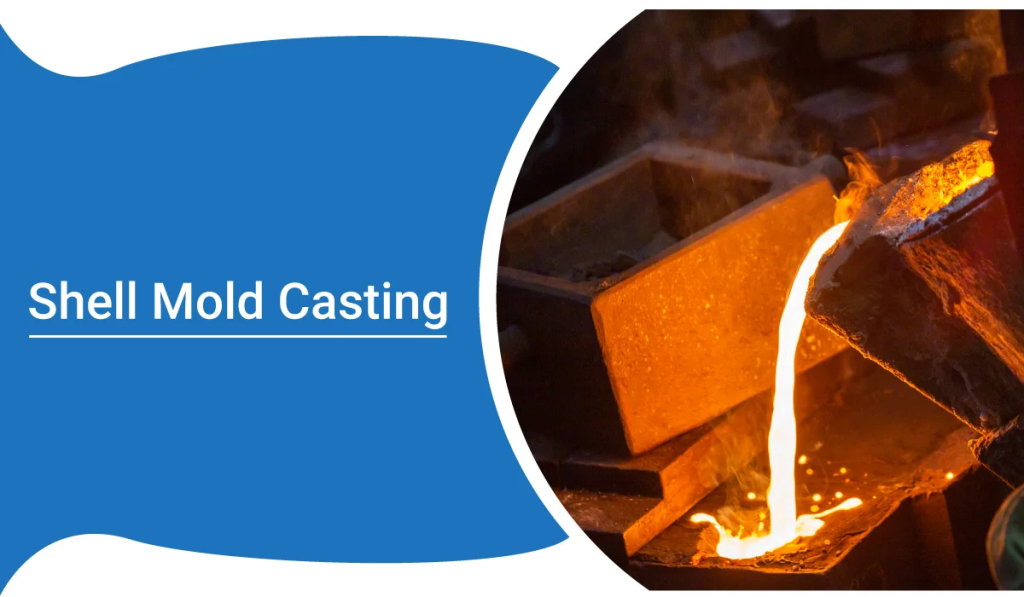
- Casting: Molten metal is poured into the shell mold to fill its cavity.
- Cooling and Removal: When the metal solidifies, the shell is broken away to reveal the finished part.

Advantages of Shell Mold Casting
1. High Precision and Detail
The rigid shell mold can hold on to fine details and intricate designs with very accurate dimensional and surface finishes. Thus, it is very much suited for the production of components that require fine features.
2. Versatility in Materials
Shell mold casting accommodates a variety of metals: iron, steel, aluminum, and copper alloys. This allows the casting to be applied in different industrial fields.
3. Increased Efficiency
The reusable patterns and thin molds decrease the waste of material and lowers the cost of production hence is efficient for medium and high-volume production.
4. Surface Quality
Surface quality of the product: It gives a finer finish as compared to traditional sand casting and reduces the time needed for secondary machining processes.
5. Dimensional Consistency
The repeatability of parts produced by this method is excellent, thus ideal for mass production.

Disadvantages of Shell Mold Casting
While it has many advantages, shell mold casting is not without its drawbacks:
- Higher Initial Costs: The metal patterns are costly, especially for custom designs.
- Size Restrictions: This method is more suitable for smaller to medium-sized components.
- Limited Sand Reuse: The resin-coated sand cannot be reused, which may increase material costs.
Applications of Shell Mold Casting
Shell mold casting is widely used in industries requiring high precision and quality.
Automotive Industry
- Engine components
- Gearboxes
- Brake system parts
Aerospace Industry
- Turbine blades
- Structural parts
Industrial Machinery
- Pump casings
- Valve casings
Consumer Products
- Decorative products
- Kitchenware
Comparison: Shell Mold Casting vs. Sand Casting
| Feature | Shell Mold Casting | Sand Casting |
| Surface Finish | Smoother and more precise | Coarser finish requiring machining |
| Dimensional Accuracy | High | Moderate |
| Production Volume | Medium to high | Small to large |
| Material Waste | Less | More |
| Cost | Higher initial setup | Lower initial setup |

Why Kbear Metal?
At Kbear Metal, we have specialized in the provision of high-quality solutions in shell mold casting to meet your needs. Here is why we are the best choice:
- State-of-the-art Technology: Our facilities are of the latest technology to ensure precision and efficiency in each project.
- Custom Solutions: We collaborate with clients to develop components that meet specific requirements.
- Sustainability Commitment: Our eco-friendly practices reduce waste and energy consumption.
- Expert Team: Decades of experience in casting ensure high-quality results.
Partner with Kbear Metal for reliable and cost-effective shell mold casting solutions that deliver exceptional quality.
Conclusion
Shell mold casting is one amazing process that can produce precise, versatile, and efficient results. It creates highly repeatable intricate designs and is therefore the choice for automotive, aerospace, and industrial machinery applications.
Limitations notwithstanding, benefits in shell mold casting outdo its drawbacks, particularly where detailed components are in order and superior surface finishes are required.
If you’re looking to harness the power of shell mold casting, Kbear Metal is here to help. With our expertise and commitment to quality, we’ll turn your vision into reality. Contact us today to discuss your casting needs!



