


Metal stamping plays a vital role in modern manufacturing, offering a fast, efficient, and cost-effective way to produce high-precision metal components at scale. From automotive parts to electronics and aerospace components, this process transforms flat metal sheets into complex, high-performance parts with impressive accuracy.
But while the advantages of metal stamping are clear—such as tight tolerances, consistency, and low per-unit costs in high volumes—it’s equally important to understand its limitations. The upfront investment in tooling and the reduced flexibility for design changes can be challenges for some businesses. That’s why choosing the right metal stamping manufacturer is essential.
In this blog, we’ll explore the key advantages and disadvantages of metal stamping, walk you through common stamping techniques like blanking, bending, and progressive die stamping, and offer insights on how to select a qualified manufacturing partner. Whether you’re launching a new product or scaling production, understanding these elements can help you make smarter, more strategic decisions for your business.
Growing at an expected CAGR of 4.7% between 2022 and 2030, the metal stamping industry continues to deliver quality products for an impressive array of businesses and industries.
However, knowing whether metal stamping solutions will provide your business with the ideal products requires a greater understanding. Let’s explore.
What is Metal Stamping?
Metal stamping is a metal fabrication and manufacturing process that uses indentation to form various shapes, letters and patterns onto sheet metal materials.
Also known as “pressing”, some common and complex metal forming techniques associated with metal stamping include the following:
- Punching
- Blanking
- Embossing
- Coining
- Bending
- Flanging
Metal stamping manufacturing processes and techniques are carefully chosen to meet the unique fabrication needs of various industries across global markets. Each technique—whether it’s blanking, bending, punching, or deep drawing—is applied based on the specific requirements of the end product. This precision ensures the production of durable, high-performance components.
Industries such as automotive, aerospace, construction, electronics, and consumer goods all rely heavily on stamped metal parts for their reliability and cost-efficiency. By using advanced stamping methods, manufacturers can deliver consistent quality at scale, meeting strict industry standards while adapting to the evolving needs of complex, high-demand applications.
The first attempts at metal stamping date back to the stamping of coins in the seventh century. Since metal stamping has continued to evolve and modernise with the times. The metal stamping industry now involves intricate and sophisticated technological advances, such as CNC (Computer-numerical control) and CAD (Computer-aided design) capabilities.
How Does Metal Stamping Work?
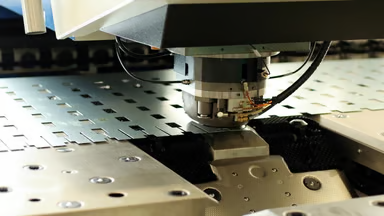
The metal stamping process involves placing cold sheet metal into a machine known as a “stamping press” or “powder press.” This press uses a specially designed metal die, which applies immense pressure to the metal sheet, shaping it into the desired form. The die acts as a mold that cuts, bends, or punches the metal, transforming the flat sheet into precise components with various shapes and features.
Depending on the complexity of the part, metal stamping can involve multiple stages, such as blanking, bending, coining, embossing, or piercing. Each stage refines the metal sheet until the final product meets exact design specifications. The process is highly efficient and produces consistent, high-quality parts in large volumes.
Metal stamping is widely used across various industries—including automotive, aerospace, electronics, and construction—because it allows for fast production while maintaining tight tolerances. The cold forming technique used in stamping also preserves the metal’s strength and integrity, making stamped parts durable and reliable. Overall, metal stamping offers an economical and precise manufacturing method for creating complex metal components tailored to specific industrial needs.
After the initial stamping process is applied, the material can proceed to undergo further treatments, such as trimming, blanking, embossing, etc.
1. Punching
The metal stamping machine literally punches the shape from the surrounding material.
2. Blanking
Typically followed by further processing, blanking involves cutting out the desired shape from the flat sheet metal material.
3. Embossing
Also known as “Pewter work”, embossing involves creating raised and shallow features onto the material.
4. Coining
Coining involves indenting a pattern onto the material through compression. The name “coining” stems from the item metal stamping was first used to create.
5. Bending
Bending involves shaping the sheet metal in one direction. Often this process is repeated to create a specific shape.
6. Flanging
Like bending, flanging involves moving the sheet metal in one direction but along a curved edge.

What Are the Advantages of Stamping?
1. One of the advantages of the stamping process is that the cost of using dies is low and the automation level is high.
The production and maintenance costs of metal stamping dies are generally lower compared to dies used in other manufacturing processes. This cost-effectiveness makes metal stamping an attractive choice for high-volume production runs. Additionally, secondary processes such as cleaning and electroplating associated with metal stamping tend to be less expensive than comparable treatments in alternative metal fabrication methods. These savings contribute to overall reduced manufacturing expenses while maintaining high-quality results. As a result, metal stamping offers a cost-efficient solution for producing durable, precise metal components across various industries without compromising on performance or finish.
2. The dimensional accuracy of stamping parts is good.
The dimensional accuracy of stamped parts is ensured by the precision of the die, which contains identical features for each production cycle. This consistency guarantees that every part meets exact specifications. Additionally, stamping dies typically have a long service life, allowing for extended production runs without frequent replacements. As a result, the quality of stamped components remains stable over time, ensuring reliable performance. Furthermore, this precision enables excellent interchangeability of parts, which is crucial in industries requiring consistent and uniform components for assembly and maintenance. Overall, the use of high-quality dies ensures dependable and repeatable stamping results.
3. Stamping can process parts with large size range and complex shape.
Because of the mold processing, parts with thin wall, light weight, good rigidity, high surface quality and complex shape that are difficult to manufacture by other processing methods can be obtained.
4. The cost of stamping parts is low.
Stamping generally does not need to heat the blank, nor does it cut a lot of metal like cutting. Therefore, its material consumption is less, which not only saves energy, but also saves metal.
5. High stamping efficiency.
For ordinary presses, dozens of pieces can be produced per minute, while high-speed presses can produce hundreds of or thousands of pieces per minute, and each stamping stroke may result in one stamping part. Therefore, it is an efficient processing method. The stamping machine is relatively easy to be automated, and can use high-end computer control programs to provide higher precision, faster production and faster turnaround time. The improvement of automation level also reduces the labor cost.
What Are the Disadvantages of Stamping?
1. One of the disadvantages of stamping is that the cost of production die is high.
The dies used in stamping process are generally special, and most stamping products are completed by multiple different stamping processes. The die needs to be newly built, and the production of customized metal stamping die is a long pre production process. Mold manufacturing requires high precision. And the mold manufacturing needs long manufacturing cycle, large investment, many unpredictable problems, and high requirements for mold technicians’ experience. It is a technology intensive product. If the design must be changed in the production process, then the mold is also difficult to change.
2. Unfriendly to single piece and small batch production
As the stamping process must have the corresponding mold, it is most suitable for large batch production. There are certain restrictions on single piece and small batch production. Only when the production batch is large, the stamping processing method will be considered. The advantages of stamping can be fully reflected, so as to obtain better economic benefits.
3. The design of stamping die focuses on classical theory and experience, requires strong imagination and creativity, and has high requirements for die designers and manufacturers.
4. Large noise and vibration during production.
5.If the precision requirements of parts are too high, stamping production is difficult to meet the requirements.
6. Material bottleneck
It is a direction of international efforts to develop and research the cold forming of high-strength steel. At present, the research on hot forming process and equipment technology has been relatively mature internationally, but the cold forming field still needs to continue to develop.
High strength steel and ultra-high strength steel have well realized the lightweight of vehicle body and improved the crash strength and safety performance of vehicles, so they have become an important development direction of vehicle steel. However, with the improvement of the strength of the sheet metal, the traditional cold stamping process is prone to crack during the forming process, which is difficult to meet the processing requirements of high-strength steel plates.

Conclusion
Kbear Metal is a precision metal stamping company and has since established itself as the leading supplier of metal stamping services worldwide. We are one of the best in the metal stamping industry. We have advanced significantly so that we can now provide our clients with unique solutions. We specialize in designing, developing, and producing plastic injection molds, electroplating, prototypes, and high-speed stamping progressive tools.



