


Lost foam casting is another of the revolutionary methods in manufacturing that has revolutionized complex part production. It involves a novel casting process by which manufacturers can produce detailed parts with less finishing work involved. Thus, it is also one of the favorites in industries where accuracy and cost-effectiveness are major requirements.
This blog will explain the process, advantages, applications, and how lost foam casting has become a game-changer for manufacturing complex parts.
What is Lost Foam Casting?
Lost foam casting is a precision casting method in which a foam model acts as the mold pattern. The foam model is coated with a refractory material and then embedded in sand, which supports the shape during the casting process. When molten metal is poured into the mold, the foam evaporates, leaving behind a cast metal replica of the original foam pattern.
This technique is especially ideal for complex and detailed parts because the foam pattern can reproduce even the smallest features with high accuracy.

How Lost Foam Casting Works
The lost foam casting process can be divided into the following key steps:
Pattern Creation
A foam model of the desired part is created using materials such as polystyrene. This pattern can consist of multiple pieces that are glued together.
Coating the Foam Pattern
A refractory material is coated on the foam pattern to create a heat-resistant shell. This coating ensures that the sand mold does not collapse during the casting process.
Embedding in Sand
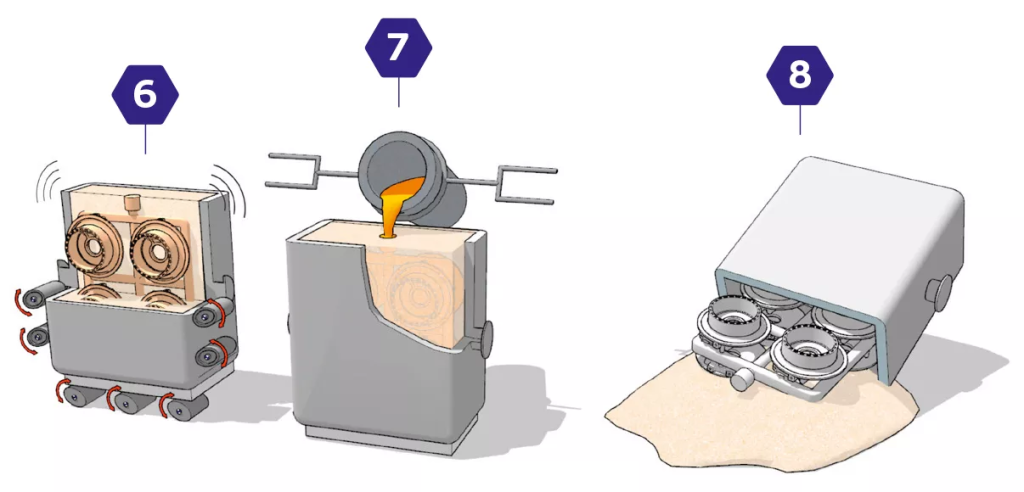
The coated foam pattern is placed in a container and surrounded by unbonded sand. The sand is compacted to hold the foam pattern securely in place.
Metal Pouring
Liquid metal is cast into the mold. This liquid metal melts the foaming agent, leaving a space that the metal fills
Cooling and Solidification
The metal cools in the sand mold and is consolidated into the final shape.
The removal of the mold along with finishing
After the casting of metal, sand falls and the casting is removed out, finishing and or some grind, machining is required.
Advantages of Lost Foam Casting
Lost foam casting provides several advantages that have made it suitable for complex component production:
1. Flexibility in Design
The foam patterns can easily produce intricate designs and features, hence enabling the production of geometries that are hard to produce through other casting methods.
2. Low Material Waste
Material waste is minimized since no cores are required, and the entire foam model is vaporized.
3. High Precision
Lost foam casting produces parts that are dimensionally accurate to very high standards and have surface finishes that are very smooth, thus requiring minimal post-casting machining.
4. Cost Effectiveness
It eliminates the need for extra cores, simplifies tooling, and reduces labor costs, which makes it highly cost-effective for small and large production runs.
5. Versatility
Lost foam casting can accommodate all sorts of materials, including aluminum, cast iron, and steel, making it versatile across various industries.

Applications of Lost Foam Casting
Lost foam casting finds widespread application in the highly complex and precision demanding fields. Some common applications follow.
1. Automotive Sector
- Engine blocks
- Cylinder heads
- Transmission cases
- Components for suspension
2. Aerospace Sector
- Turbine blades
- Airframe componentry
- Complex brackets
3. Machinery and Equipment
- Pump housings
- Hydraulic components
- Equipment and tools for industry
4. Medical Devices
- Surgical instruments
- Prosthetic parts
- Critical diagnostic equipment
5. Energy Sector
- Components in wind turbines
- Components in Nuclear Reactors
- Exploring equipment for oil and natural gas

How Lost Foam Casting Revolutionizes Complex Component Production
1. An Uncomplicated Process
Lost foam casting eliminates the need for traditional cores and multiple mold components, thus simplifying the manufacturing process. This simplification reduces setup times and production costs.
2. Achieving High Accuracy
The ability of the foam pattern to replicate even the smallest details ensures that manufacturers can produce parts with unmatched accuracy. This precision is particularly important in industries like aerospace and automotive, where tolerances are critical.
3. Lowering Costs
By minimizing the amount of machining and material waste, lost foam casting reduces the cost of production. It is very economical for both prototype development and mass production.
4. Facilitating Sustainable Manufacturing
Lost foam casting is an environmentally friendly process. It minimizes waste, uses recyclable materials such as sand, and reduces energy consumption compared to other casting methods.
5. Expanding Material Options
The process can accommodate many varieties of metals and alloys, giving manufacturers more flexibility toward specific performance and durability needs.

Limitations of Lost Foam Casting
While lost foam casting offers many advantages, some of its limitations include:
- Creating foam pattern: Creating the foam pattern is time-consuming. In some cases, it may require specialized equipment.
- Not Suitable for All Sizes: The process is not so effective for very large or heavy parts due to mold support limitations.
- Sand Compaction: Poor sand compaction may result in defects or irregularities in the final casting.
Despite these limitations, technological and material developments are continually enhancing the efficiency and scalability of lost foam casting.
Why Kbear Metal for Lost Foam Casting?
At Kbear Metal, we specialize in lost foam casting to deliver exceptional precision and quality. Here’s why we’re the ideal partner for your casting needs:
- State-of-the-Art Facilities: We use advanced equipment to ensure high accuracy and efficiency.
- Customized Solutions: Our team works closely with clients to meet unique design and material requirements.
- Sustainability Focus: We prioritize eco-friendly practices, reducing waste and energy use.
- Commitment to Quality: Every casting goes through rigorous quality control to ensure that it meets your precise specifications.
Conclusion
Lost foam casting has revolutionized complex part manufacturing with unmatched precision, versatility, and cost-efficiency. From the automotive to the aerospace, this innovative process makes possible intricate parts with several varied options in the highest range of performances.
If you are willing to explore the possibilities of lost foam casting for your project, Kbear Metal can help. Contact us today and learn more about our services, and how we can bring your designs to life!



