


Different types of fasteners play a vital role in maintaining equipment’s functioning by holding machine parts in place against excess force, vibration, and pressure. Created by precision components manufacturers, these are used to join two or more objects mechanically in a permanent or non-permanent fashion.
While permanent fasteners, like nails and rivets, are used for a permanent joint and can be only used once, non-permanent fasteners are designed for easy removal and re-use and consist of bolts, pins, and screws.
Both fasteners are widely used in various industries and for assembly of products. There are different types of fasteners, each with their purpose. Read on to learn more about different fastener types and the role of high-tensile fasteners.
What is Fastener
Kbear Metal is a top fastener manufacturer in China, offering a wide range of bolts, nuts, screws, washers, and other stainless steel fasteners in all sizes at the best factory prices for you.
Fasteners are hardware pieces that mechanically join multiple materials or objects together. Types include bolts, screws, anchors, rivets, nails, spikes, and staples, which secure materials through mechanical friction or with another fastener. Nuts, pins, safety lock wire, and retaining rings help secure these fasteners in place. Spacers, standoffs, washers, shims, and shim stock ensure correct spacing and alignment to prevent damage.
KBear Metal is a quality nuts and bolts fasteners manufacturer that has been supplying standard and custom fasteners supplier since 1989. We offer a wide range of standard and metric fasteners in materials like steel, stainless steel, brass, silicon bronze, Hastelloy, Inconel, Monel, aluminum, alloy 20, 17-4PH, 17-7PH, titanium, and other non-ferrous metals. We supply over 100,000 different fastener components.
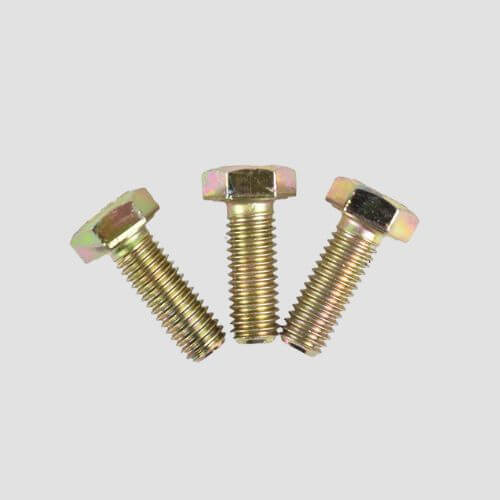
Different Types Of Fasteners
Various high-tensile fastener manufacturers in India produce a variety of permanent and nonpermanent fasteners. The most commonly used fasteners can be broadly categorised into:
1. Screws Fasteners
One of the most common types of fasteners, screws, are used for residential as well as industrial purposes. These fasteners have an external self-threading, enabling them to fit into components without tapping.
A screw is used to hold two objects together and can be of the following types:
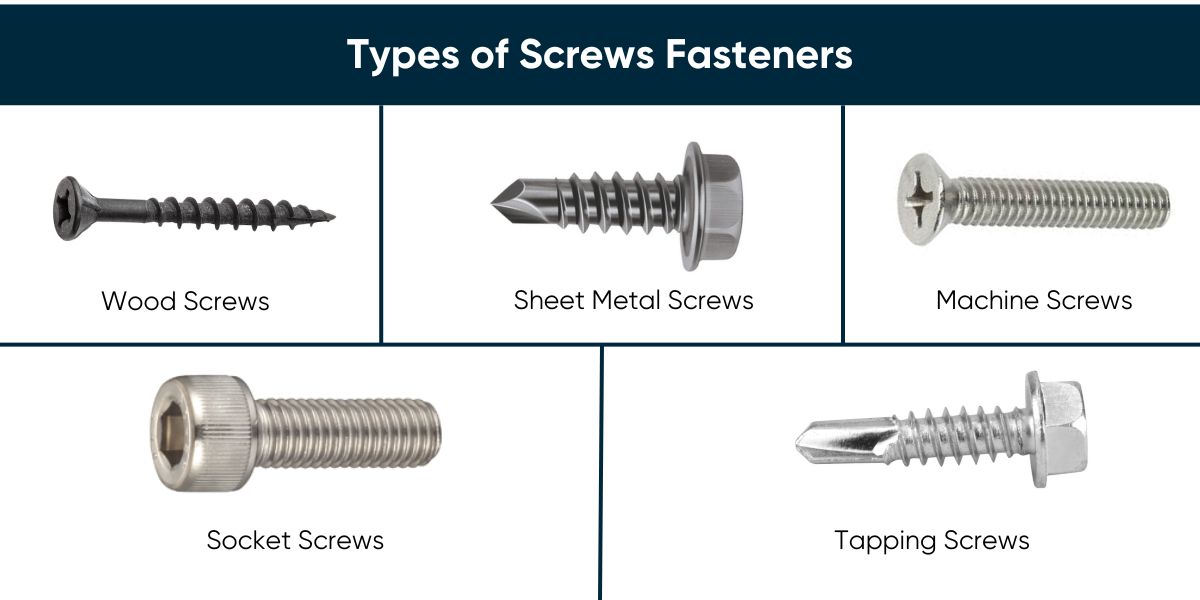
Wood Screws
These types of fasteners have a tapered head, enabling them to sink into the material. Therefore, they are used to join wood.
Sheet Metal Screws
Having a structure similar to that of wood screws, sheet metal screws are made for attaching metal to materials like plastic and wood.
Machine Screws
These screws are thicker in size and have a high tensile strength, enabling their use in machinery and appliances. In addition to external threading, they also contain internal threads and have a cylindrical head.
Moreover, machine screws can easily be inserted into pre-drilled holes. These fasteners are available in different lengths, sizes, and diameters, making them one of the most widely used and versatile types of fasteners.
Socket Screws
Used as permanent fasteners for sheet, wood, metal, and other materials, socket screws require an Allen key. These screws can be further divided into different types based on their head shapes, such as socket, flat, and button heads.
These generally offer high-quality results and superior robustness compared to other mechanical fasteners.
Tapping Screws
Designed to be tapped directly into pre-drilled holes, tapping screws are designed with a pointed tip and threaded shank. These are, therefore, ideally used in metal sheets.
Tapping screws provide high strength and resistance to shock and vibration, making them useful for automobile and construction projects.
2. Nuts And Bolts
Nuts and bolts are commonly used to connect separate pieces. While the bolt is inserted to join the parts, nuts secure the bolt on one end. In general, these are used to join metal to wood.
Following are a few common types of nuts and bolts:
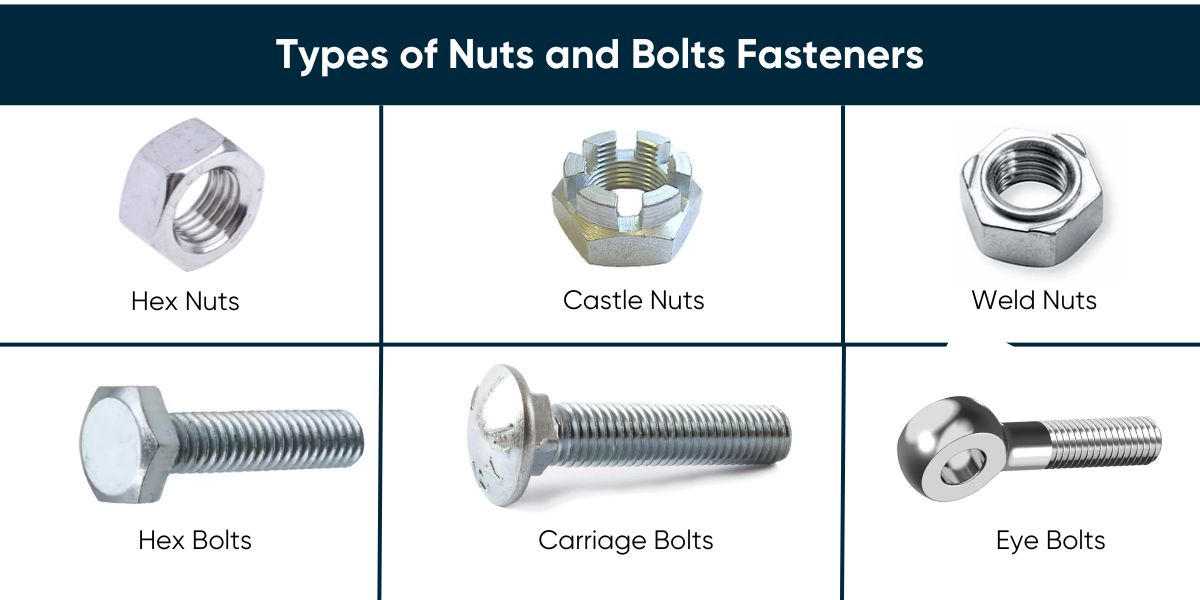
Hex Nuts
Hex nuts, made from high-quality steel and available in different sizes, are commonly used in wood and metal projects. They have a six-sided head and can be easily tightened with a wrench.
Castle Nuts
Used for mechanical fastening, castle nuts have slots or notches on one end to enable the placing of pins, helping secure them in place. This makes it ideal for projects requiring low torque levels and a tight connection, as their removal requires removing the pins first.
Weld Nuts
Weld nuts, which have an internal thread with a slap or rounded head, are commonly used in industrial applications to secure components to difficult-to-reach surfaces.
These nuts are welded into place, ensuring a permanent connection between wood and metal sheets.
Hex Bolts
Commonly used in machining and hardware industries, hex bolts have a hexagonal shape with internal threads, allowing them to be screwed into threaded holes. These are generally used for securing metal and wood connections.
Carriage Bolts
These bolts, used for wood joining, have square necks and convex metal heads. They also have internal threads, creating a self-locking and secure connection. These types of bolts don’t require pre-drilled holes.
Their flat head also makes them ideal for furniture construction and outdoor projects, providing high-quality results.
Eye Bolts
Eye bolts, which are used to attach a chain to any surface, have a circular ring and internal threads. Moreover, these high-tensile bolt grades have a smooth shank, enabling extra strength for joining metal to other materials.
3. Rivets
Rivets are permanent fasteners used in industries to fasten metal sheets and plates together. They are ideal for high-strength applications and provide a single-use, unremovable solution.
Rivets generally have a cylindrical shape with a long shank. The head can be hexagonal or rounded.
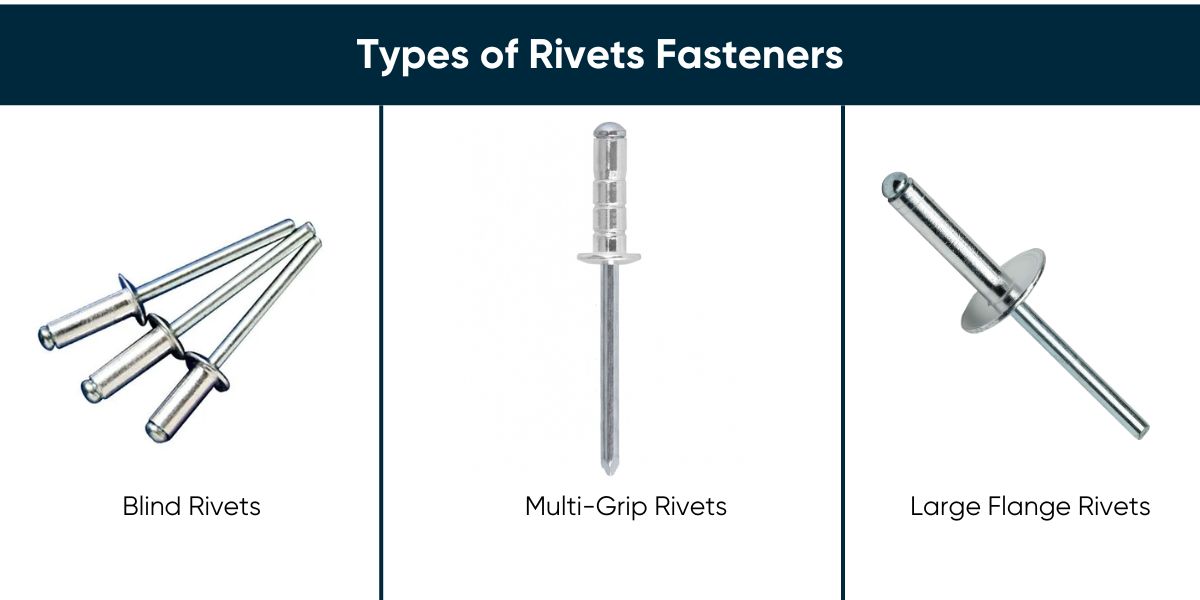
Blind Rivets
These rivets have a tubular design and may be open-end, with an oval-shaped head and internal threads, or closed-end, with a rounded head and smooth shank, enabling their use where one side of the assembly is inaccessible.
Multi-Grip Rivets
These are used in case the installed materials have differing thicknesses, as they can expand to the required size.
Large Flange Rivets
These types of rivets have larger washers on their hats, enabling quick and efficient joining of materials.
4. Washers
Washers also find applications in multiple industries. However, they are generally used with joints and nuts, helping prevent the loosening of components due to vibration and reducing friction.
In addition, washers can help prevent leakage by isolating different components. Depending on their application, these can be made of plastic, metal, or rubber. Different types of washers include:
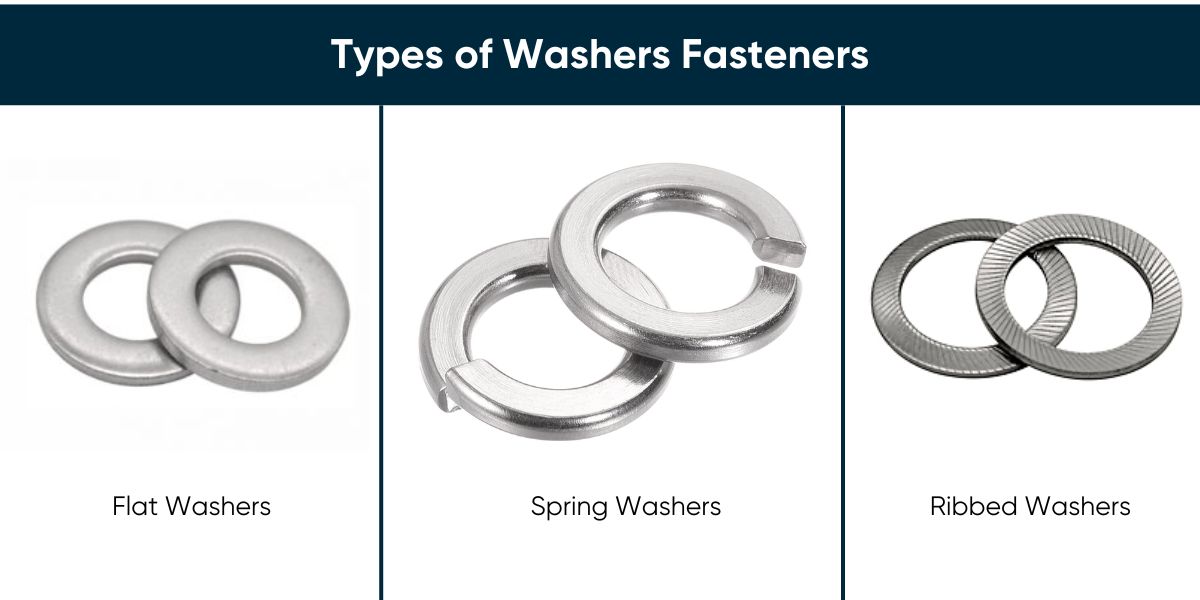
Flat Washers
These help distribute the load of a screw, bolt, or nut in an even manner and secure the attachment.
Spring Washers
Also known as split washers, spring washers can increase tension in bolted joints and help prevent the loosening of nuts and bolts. They can be made of plastic or metal and have a split down one side.
This split enables them to act as springs between two surfaces, adding flexibility and reducing vibration.
Ribbed Washers
With their raised edges or teeth, these washers help provide extra strength and grip to a joint. They are commonly used with bolts or threaded rods.
5. Nails
One of the most common types of fasteners found in every household and construction project, nails are available in multiple shapes and sizes. While the general nail is characterised by a large and flat head and a thick shank, other types of nails include:
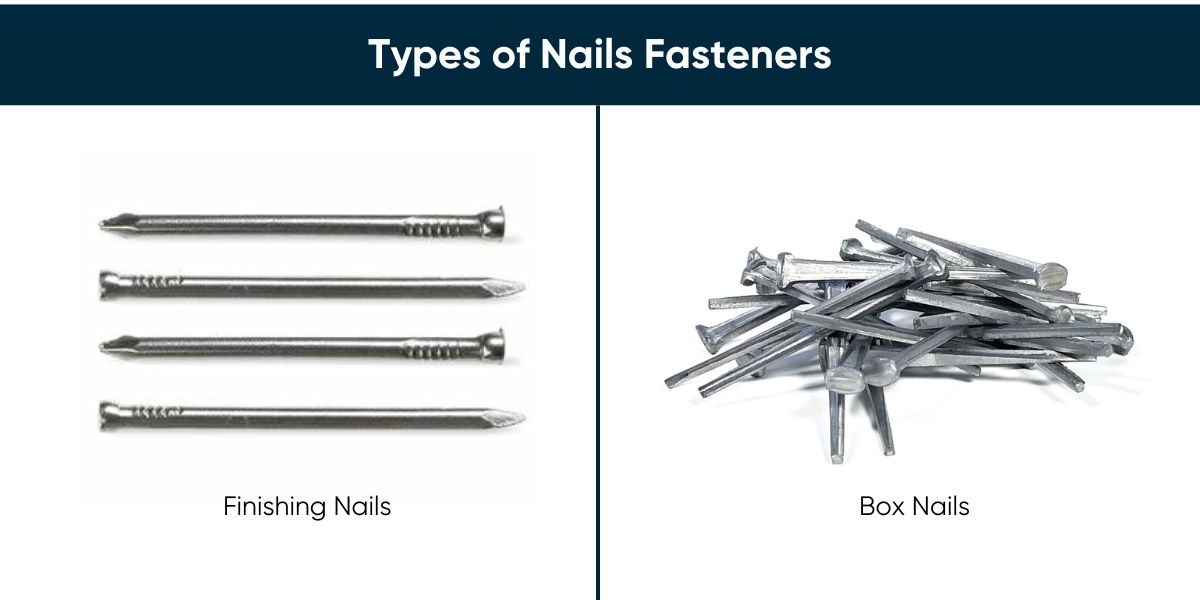
Finishing Nails
These are smaller, and their flat heads allow them to blend in with the surface. They are commonly used for crown molding.
Box Nails
They have a steep shaft and diamond-pointed tips, enabling their use in framing and construction.
How Fasteners are Made?
Several methods are employed to produce nuts, bolts, clips, screws, and other types of fasteners. The three most common methods are machining, cold forging, and hot forging. These techniques are widely used for forming and producing metal parts.
The selection of a production method depends on factors such as the type of fastener, the metal used, and the desired quantity. Some methods are more suitable for producing large quantities, while others are better for specific metal types and their characteristics, such as pliability and elasticity.
Machining
Machining is a process used to shape metals into parts and components through various cutting techniques. This includes operations such as cutting, drilling, turning, milling, and grinding to achieve the desired form. Unlike molding and casting, machining operates at room temperature or slightly above, with friction being the primary source of heat rather than an intentional heating process.
In machining, a round or hexagonal metal piece, known as the workpiece, is transformed through threading and shanking to meet specific geometric requirements. The process can be performed on a Computer Numerical Control (CNC) machine, which enhances efficiency by allowing multiple processes to be executed simultaneously.
The advantages of machining include high precision, exceptional tolerances, and the capability to create complex geometries. However, it is a time-consuming process best suited for short runs or minimal quantities.
Cold Forming
Cold forming, or cold roll forming, is a widely used method for producing fasteners due to its efficiency and minimal waste generation. Performed at or near room temperature, this method enables the rapid and cost-effective production of large quantities of fasteners.
The process begins with a coil of wire that is straightened and sheared to the required length. These pieces are then fed into a rolling machine, where they are shaped and detailed with high precision. The pressure applied during cold forming preserves the metal’s original grain structure, which enhances the tensile strength of the final product.
Cold forming encompasses several techniques, including upsetting or heading, extrusion, and rolling. In the upsetting process, the workpiece is deformed at one end to increase the cross-sectional area. Extrusion involves applying compressive force to cause deformation heat, which can be applied at different angles. Cold roll forming applies pressure to shape the workpiece into the desired form.
Hot Forging
Hot forging is employed for producing fasteners when machining or cold forming are not suitable. A critical aspect of hot forging is the heating of the workpiece to its recrystallization temperature, which can reach up to 1200°C (2192°F). This high temperature enables the metal to retain its deformed shape as it cools.
During the forging process, the metal’s grain structure is refined and homogenized, resulting in improved strength, ductility, and toughness. Hot forging is noted for its efficiency, as it generates minimal scrap and waste compared to other metal forming methods.

Metals Used to Make Fasteners
When selecting the appropriate metal or fastener for an application, several factors must be considered, including the intended location, environmental conditions, and exposure to moisture and heat. While heavier metals might appear suitable, they can underperform or fail if not matched to the specific conditions of the environment.
Steel
Steel is the most commonly used metal for manufacturing fasteners. It can be used in its plain form or with surface treatments like galvanization.
Steel fasteners are typically made from various grades of steel, including Grades 2, 5, 8, as well as alloyed steel.
- Grade 2: Most common and least expensive
- Grade 5: Hardened to increase strength and used in automotive applications
- Grade 8: Hardest of the three and used in demanding and stressful applications
Alloyed Steel
Alloyed steel fasteners are known for their exceptional strength and are typically heat-treated for enhanced durability. They usually come with a dull black finish to provide additional protection.
Stainless Steel
Stainless steel is highly suitable for fasteners due to its resistance to corrosion and rust, maintaining these properties even if scratched during installation. It comes in various grades, each offering distinct characteristics and advantages.
- 18-8 Stainless Steel: The most common stainless steel.
- 316 Stainless Steel: Exceptionally resistant to corrosion and ideal for salt water and chlorine environments.
- 410 Stainless Steel: Harder than 18-8 but less resistant to corrosion.
Aluminum
Aluminum is typically alloyed with other metals when used for producing fasteners. For example, rivets are often made from 5000 series aluminum. These added alloys enhance aluminum’s strength and increase its melting point.
Brass
Brass is an alloy of zinc and copper, known for its softness, corrosion resistance, and electrical conductivity. It is often chosen for its aesthetic appeal.
Bronze
Bronze, an alloy of copper, tin, and a small amount of silicon, offers superior corrosion resistance and strength. It is suitable for use as a non-permanent fastener due to its ability to be re-fastened.
Choosing The Right Fastener For Your Industry Application
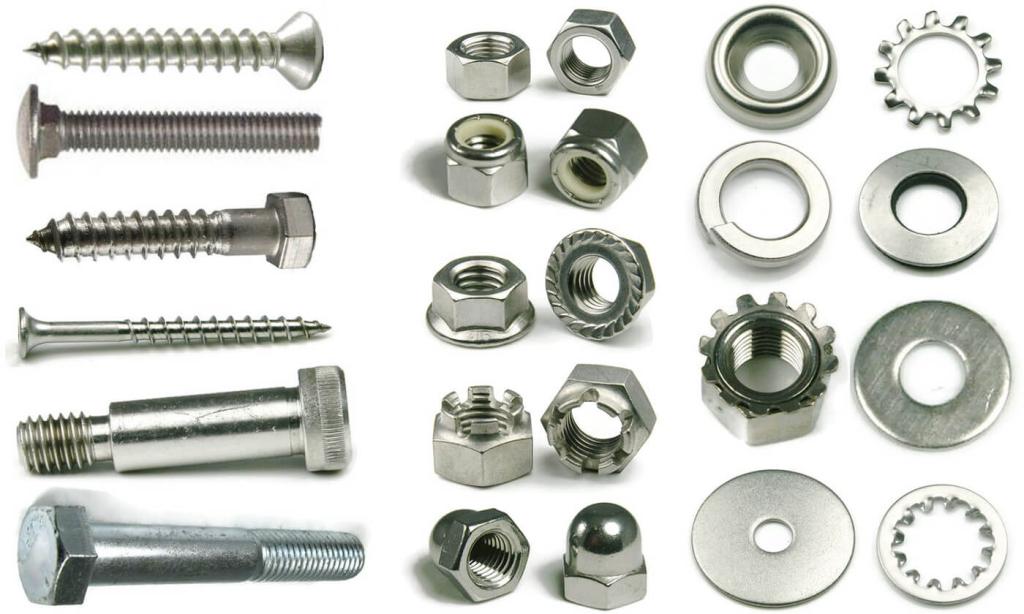
Selecting the right type and size of fastener according to your requirements is essential for a long-standing and secure joining. Therefore, when selecting a fastener, you must consider its application and the properties you require with the best high-tensile fastener manufacturers in China.
Once you have decided on the type of fastener you need, you can source them from top manufacturers, such as Kbear Metal, who can provide you with high-quality products.
Conclusion
A fastener is a non-permanent or permanent mechanical tool that rigidly joins, or affixes two surfaces or objects together.
There are an endless number of shapes, sizes, lengths, and varieties of fasteners that range from the common nail to huge bolts to hold heavy duty manufacturing equipment in place.
The group of permanent fasteners do not have threads and can be quickly installed without the need of extra fastening components.
Washers relieve friction, stop leakages, maintain tension, prevent corrosion, and serve as a spacer or separator.
The three methods used to produce fasteners are machining, cold forging, and hot forging; these are commonly used methods for forming and producing metal parts.



